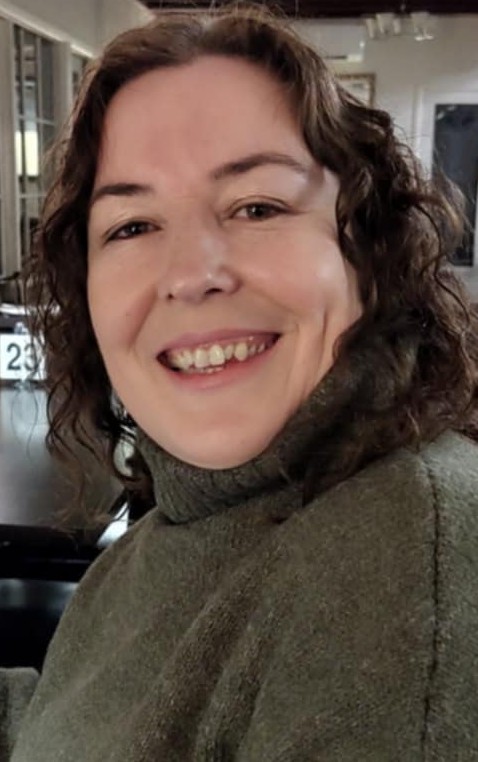
AAWAA brings to you Local Action — interviews with women Getting It Done across Australia. In this edition of Local Action, we talk to Stassja Frei. Stassja holds a special place in my heart as the quintessential TERF, and she’s certainly one of the first Australian TERFs to pop her gorgeous head over the parapet. Stassja started the Facebook page and group Coalition for Biological Reality, drawing together women’s rights activists from all over Australia and across the political spectrum.
Alongside Angela Jones, Stassja pioneered the TERF movement in Australia with the groundbreaking TERF TALK DOWN UNDER, a weekly podcast on the Gender Wars in Australia. More recently, she has turned her hand to podcasting with DESEXING SOCIETY — the only in-depth analysis of the rise of Gender Ideology in Australia and its effect on women’s rights. Stassja has been Getting It Done!
You are a feminist hero in Australia. When did it all start for you?
It was 2020. It actually started with the Black Lives Matter protests. I don’t know if you
remember, but there was this footage of people dining outside — it was during COVID —
and a group of protesters walks past, demanding that everyone put their fist in the air.
This one woman just refused. There’s a photo of her sitting with her arms folded across her
chest, leaning back, and this mob of kids — white kids — is in her face. I put myself in her
shoes and thought: This is not good. Actually, this is really bad.
It was intimidation, harassment, and menacing. I was terrified to be that woman. That was my first inkling that something was very wrong.
Then, only a month or two later, J. K. Rowling’s essay came out. I kept seeing the headlines
everywhere, but I didn’t bother reading any of the articles. I resisted for a couple of weeks.
Eventually, it popped up in my Facebook feed — posts calling Rowling a transphobe. So I
thought, Fine, I’ll read one newspaper article about it.
I read it and remember thinking, I don’t know what the big deal is. What has she done wrong?
I wasn’t seeing anything in what she said that was so terribly transphobic. So then I thought,
I’ll go read her actual essay for myself.
And I did. And I was like — Why is everyone up in arms? I totally agree with this woman.
These are troubling things.
Not long after that, I got into my first Facebook fight with a trans activist. She was completely unhinged. She said, “You think infertile women aren’t women.” I said, “I never said that.” Then she brought up intersex people. I didn’t know anything about DSDs at that point.
We’re all experts on DSDs now…
Honestly, this woman came across as though she had a personality disorder — she was just off the rails. That prompted me to start reading about intersex conditions. So yes [laughingly], I am basically an expert on intersex conditions now.
A few months later, I was thinking, I need to do something about this. It was just so shocking to me.
At that time, I hadn’t really found the others here in Australia. I didn’t know there was already a resistance underway. So I started this group — and that’s how Coalition for Biological Reality came to be.
I loved that — I had been arguing with TRAs too.
I look back on it now and I have to chuckle, because I was very ambitious. I wanted to bring together all the different groups who cared about these issues.
It became a mix of left-wing women and conservative women, Christians, and everyone in between. It was always quite dominated by the left-wing radical feminists, because they were the first wave of women to join.
Someone had advertised the group in a radical feminist space, so all the radfems from Australia and New Zealand ended up in my group. They really dominated the space — which is fine!
But you know, I didn’t have any prior experience in this kind of organising — I just went into it thinking it would be easy because we all agree on this stuff. But it was not easy.
So that was in 2020. Then in 2022, during the federal election when Katherine Deves ran, things just went crazy in the group. The conservatives and the radical feminists were at each other in the comments. It was a nightmare to moderate during that period. That’s when it really hit home for me that different gender-critical factions just had to do their own thing.
After the group had been running for a while, I started the Biological Reality Facebook page.
Every morning, I would scan the papers for articles to see if anything had been published on the transgender issue. I’d make them accessible by using the archive website. I was doing that for The Australian, Daily Mail, and Daily Telegraph. Those were the main newspapers covering the issue. Every now and then, the ABC would come out with something too.
I would read everything, every morning. I never posted an article without reading it first. I wanted to know what the content was — which was really handy when I was doing TERF TALK. I was completely on top of all the news happening around Australia. I was already prepared. All I needed to do was scroll through the Facebook page from the past week and I had my content for TERF TALK.
How long did TERF TALK go for?
TERF TALK ran for a year — all of 2022. We platformed 50 different women, helping to get their experiences out there. It was also a neat little summary of the week for busy women. I think it was really useful. Some women even told me they had a Friday night ritual: glass of wine, fish and chips, and TERF TALK. It was a great way to finish the week.
It was really refreshing to hear Australian women talk about women’s issues.
TERF TALK was another one of those situations where I just jumped in without giving it too much thought — just like with the Coalition for Biological Reality. Ange approached me a couple of times, asking if I wanted to do a YouTube show with her, and my reluctance was really about not wanting to put my face on video.
Before COVID, I had never even used Zoom! That was my biggest hesitation. I didn’t really think about what we were doing. We were putting ourselves out there, and trans activists could easily come after us. I didn’t consider any of that beforehand.
Do you know the Tarot card The Fool? That’s me.
Did you get harassed by any TRAs?
Not really. It was funny, because I wasn’t on Twitter back then — Ange was. I think that’s where a lot of the harassment happened. Since I wasn’t on there, I just sort of flew under the radar. I’m not sure what it was like for Ange.
They mostly ignored us. We’d get the odd comment here and there on our videos, but it wasn’t too bad.
When Katherine Deves’ election campaign blew up and it was front-page news for two weeks straight — she had been on TERF TALK — Channel 10 referenced us. It was wild to think Channel 10 journalists were watching us! They used a little clip from TERF TALK on the news one night, and I was like, WOW.
When you’re running a YouTube channel, you’re thinking about your audience and your fans — you forget the rest of the world can also see what you’re doing. But that was a proud moment. TERF TALK got five seconds on mainstream TV.
You organised the Tasmanian conference…
I think that was also in 2022. The organising must have started in 2021. Originally, it was being organised by a woman in Launceston. She really did the hard yards at the beginning. It was actually Isla McGregor’s idea, Women Speak Tasmania. Isla convinced this wonderful Launceston woman to take it on. She organised the venue, which was itself a political statement — getting Hobart Town Hall. Hobart City Council is so woke.
Because of COVID, it was postponed two or three times. In the midst of all that disruption, the original organiser decided to step down. She didn’t have the time anymore — being a mum and working full-time. She dropped out, and I took over.
Eventually, the event went ahead. Just two days before, COVID restrictions were relaxed, so we were finally able to run it.
We had an okay turnout — a good turnout, actually — but the trans activist turnout was at least double our numbers. Some interesting things happened. The council flew the trans flag on the Town Hall on the day of our event, which was so petty.
We’re quite certain that decision came directly from the Lord Mayor herself, Anna Reynolds. In fact, FOI requests showed that Equality Tasmania had given the council advice to fly the flag.
Something really dodgy like that. It was a clear breach of the Hobart City Council’s code of conduct. We tried to hold her accountable, but we were unsuccessful. When you’re appealing to people who are trans activists, you’re never going to get the outcome you want.
I was quite proud we managed to pull that event off. We had Senator Claire Chandler as the keynote speaker, along with Holly Lawford-Smith, Katherine Deves, and Dianna Kenny, who spoke via video. We even got Exulansic to join for a presentation, and Professor of Law Patrick Parkinson. I learnt a lot during that time—one big thing I learnt is that I’m not into event organising. So much work!
It was very successful…
…and it forced the trans rights activists out into the streets.
Do you think if it had been in another part of Australia, it would have attracted so many trans rights activists?
I think it would have. Melbourne, definitely. It turns out Hobart is a bit woke. I think it attracts a lot of tree-hugging hippies. Unfortunately, all the social justice stuff and climate activism tends to go together. I wouldn’t have guessed that about Tasmania, but it seems that was the case.
At one point, I remember thinking environmentalists should really care about trans ideology. Think about the hormones going into the water system. If you’re vegan, consider that one way oestrogen is harvested is from horses. These are things environmentally-minded people might want to be concerned about.
That event was our one big moment. I had thought about doing one in every state, but I lost steam. I was also getting distracted by the issue of men in women’s prisons.
A man had sexually assaulted a woman on a busy public street, and he had been placed in a women’s prison because he announced that he identified as a woman. I organised a protest around that. We made signs and corflutes, and went to Parliament House on a Saturday or Sunday. About 40 of us showed up. We had a megaphone, we did our thing, and then we went to the pub afterward.
Even organising that was immense. These things don’t just magically happen—there’s a lot of work behind the scenes. Hats off to all the women who give it a go.
There was one other protest we did before that, outside the Victorian State Health Minister’s office. That was against the use of puberty blockers. It was funny because it was about five radical feminists and ten conservative Christians. Moira Deeming and I organised that together.
Then you went on to produce your amazing series, DESEXING SOCIETY.
Towards the end of 2022, I had been a full-time TERF for two years. I told Ange I was taking three months off from TERF TALK, and I basically bludged.
Part of that bludging was listening to podcasts—I got really into cult podcasts. There is so much overlap between the transgender agenda and cults. I started thinking, I reckon I could make an audio documentary.
At the same time, I had become friends with a woman in Melbourne. She contacted me and asked if I’d be interested in making a documentary about all of this. I said, “Yes! Let’s do it.”
So we started interviewing various TERFs. But eventually, I realised I didn’t have the technical skills to make a film. After listening to so many podcasts, I thought: I don’t have the skills to make a film, but I bet I can make an audio-only podcast. It removes ten layers of difficulty. So I decided to give it a try.
Part of the motivation was that you end up having the same arguments over and over on social media. I thought, Wouldn’t it be great if all of those arguments were just in one place? That was my thinking.
And you know, the media here in Australia is so bad at covering these issues. I thought, If the media isn’t going to do it, I will. So, I did.
I did a big road trip up to Brisbane and Sydney, then back to Melbourne. I got back just in time for the Let Women Speak event. After what happened with the neo-Nazis and all that, it became a huge distraction, so I didn’t start working on the podcast until July.
There’s nothing more powerful than taking the piss out of Nazis by posing in a fun way in front of them in fancy dress and a hat. You were clearly mocking them. How anyone could look at that photo and think you were supporting Nazis is beyond me!
Thank you. That’s what I thought too. The juxtaposition of me in a rainbow unicorn wig and the Nazis proves I’m not one. But to tell you the truth, when I posed in front of them, I didn’t know they were Nazis. I hadn’t seen them do the Hitler salute. There wasn’t a swastika flag.
So it was really unfair for us to be branded as Nazis—by so many, including some TERFs. There were some TERFs who were really scolding of me for that photo.
I just wish women would have each other’s backs.
I don’t know everything you’ve been through, but I do know that most women have your back and love your work. Only a small number of women would be so petty as to condemn you for that photo. But back to your podcast—how was it?
There were times during the writing process when I honestly thought I wouldn’t be able to continue. It was so labour-intensive. The trick, as I discovered, is that you just have to be consistent and work on it every day. Just chip away at it, and eventually it all gets done.
I took about a month off in the middle because I was completely exhausted. I was freaking out about the scale of the project and the fact that I’d said I was going to do it—so now I had to. I thought, I’ll feel even worse if I don’t do it.
Eventually, I typed “motivation” into YouTube, and one of the top videos was a compilation of those podcast bros. Mixed in there was Joe Rogan talking about a book called Do the Work. The main advice was simply: Just do it. It’s so ridiculously simple. You just have to show up, even when you don’t feel like it. So I took that on board and read the book.
The best advice in there was about resistance—how you can actually use it as a compass to guide you toward what you’re meant to be doing. After taking that on board, I finally got there in the end.
I published 8 episodes. It was a bit nerve-wracking, because I was worried I’d be making myself even more of a target. In Season 1, I go after the Melbourne Royal Children’s Hospital—a huge public institution with money and influence. So far, I’ve managed to stay under the radar. No one has come for me.
Season 1 hasn’t reached as many people as I had hoped, but maybe that’s a good thing. It’s meant I haven’t been too distracted while working on Season 2.
The feedback I have received has been overwhelmingly positive. One message really stood out—a woman sent the podcast to her mum. Her mother had always brushed her off, saying, What’s the big deal? But after listening, her mum said, I get it now. I understand why this is such a bad idea and why you’re obsessed with this topic. It really is important.
Part of the reason I’m so invested in this issue is because I’m certain I would have been one of those girls who identified as trans. I would have been totally sucked into the belief system. I was somewhat gender non-conforming as a kid and teenager, and I come from a family where women were considered inferior. I would have really latched onto it.
So part of my involvement is about trying to protect my younger self.
That’s powerful…
I wonder if that’s what’s going on for a lot of TERFs. The internet has been terrible for
women. The amount of internet traffic that’s just porn-related is staggering—it’s a huge
percentage. It’s really sad for girls growing up in this environment.
Even Courtney Coulson, a detransitioner I interviewed in Season 1, said that after she detransitioned, she felt like it meant she had to start acting “feminine” again. So she went back to wearing makeup, doing her hair, and dressing a certain way. Eventually, it clicked for her that she didn’t have to do all of that just to be a woman.
I found that so interesting. And she’s not the only one. I also mentioned the story of another detransitioned woman from the Netherlands. She said the same thing—she spent a year or two considering detransitioning, but part of what held her back was the idea that she’d have to be traditionally feminine again.
How in the fuck are we still teaching kids to think this way?
We still haven’t managed to beat the stereotypes. It’s just so hard to shake off the conditioning society imposes on us.
Years ago, I read about a study showing that women who wear makeup are perceived as more trustworthy. It was an experiment where people were shown women’s faces and asked to rate them based on how trustworthy they looked. They found that people respected women with makeup more and rated them as more trustworthy.
There was another study looking at customer service—how women are treated depending on their appearance and whether they’re wearing makeup. Apparently, to get decent service, women need to wear makeup.
I’ve carried that with me ever since, and it’s made me more self-conscious about going out bare-faced. It’s such an awful situation. Wear makeup, and you’re submitting to this terrible state of affairs. Don’t wear makeup, and you’re deemed untrustworthy and get treated badly.
When I started season one, I didn’t know what I was doing. The interviews I conducted—I didn’t always ask the right questions. I came back to Melbourne with no idea where to begin. But eventually, I found my feet.
Originally, I thought I’d just write one season—eight episodes—and that would be it. I imagined I could cover everything: the medicalisation of children, women’s sport, women’s prisons, all in one neat series. But that wasn’t realistic. It ended up taking three episodes just to explain the medicalisation of children, and another two to unpack what’s happening in schools across Australia. At some point, I realised women’s rights would have to wait.
All those interviews I recorded with TERFs around Australia—I’m only now working on them. It’s been two years since most of those conversations. Of course, some things have changed in that time—or actually, now that I think about it—nothing has changed!
I’ve been working on season two since September last year, and it’s finally coming out in June. I’m about to start recording. I want to apologise to everyone who’s been waiting—it’s taken much longer than I anticipated.
Like season one, it’s a summary of what’s going on in Australia, and a crash course for those who are new to these issues or still on the fence. But even the most committed TERFs—people who’ve been deep in this for years—have told me they’re learning something new from every episode of season one. That’s been really encouraging. I did worry, for example, that episode one of season one might come across as too basic, or even boring, for long-time TERFs.
In season two, I’ll be covering women’s sport, ACON, women’s prisons, language, healthcare—basically all the major areas where we’ve been impacted by autogynephiles. It’s a bit longer than season one—this time, we’re doing twelve episodes. And as I’ve been working on season two, I’ve realised: there’s definitely going to be a season three.
Season three is already percolating in my mind. It’s going to focus mostly on women’s stories of cancellation. For example, I still haven’t shared Katherine Deves’ cancellation story from when she ran for the seat of Warringah. I need to cover Let Women Speak. Honestly, this could go on forever.
At one point, I thought I might go to New Zealand and tell the New Zealand story—but like I said, it could go on forever. At some point, I would like to move on to another topic.
I’ve done a very feminine and altruistic thing—I’ve put my own needs behind those of the movement and left the podcast free to access. Because, really, I just want to get this information out there.
Final question. What would you teach young women today based on your experience?
This isn’t an original idea—I’ve seen it on social media—but it’s important:
Stop giving a shit what boys think of you.
Stop chasing approval from boys.
Just go out there and do your own thing.
Become your own woman.
Girls get so caught up in needing to be in a relationship, and I think that starts at a young age. For our generation, it was Disney movies programming us to believe we’d find our Prince Charming. Today, that is still the message, just in different forms.
Girls need to know they don’t need a relationship with a boy. They need to focus on becoming their own woman first.
Check out Stassja’s incredible podcast Desexing Society on YouTube.
The podcast is free to listen to—but it’s not free to produce. Please consider donating to support Stassja’s work. You may choose to match any donations to AAWAA so we can continue to advocate for the protection and advancement of women and girls.
The views expressed by the women interviewed in Local Action are their own and do not necessarily represent or reflect the positions of AAWAA.
