AAWAA presents ‘Local Action’—interviews with women making a difference across Australia. In this edition, we speak with Carole Ann. She and the women of the Lesbian Action Group are steadfast in their belief that men cannot be lesbians. After gender ideology eroded lesbian-only spaces in the 1990s—demanding that men be included in lesbian events—many women withdrew from public activism. However, after witnessing the hostility towards women at the Melbourne ‘Let Women Speak’ event in 2023, Carole Ann and the Lesbian Action Group decided to take a stand once more. This is their story.
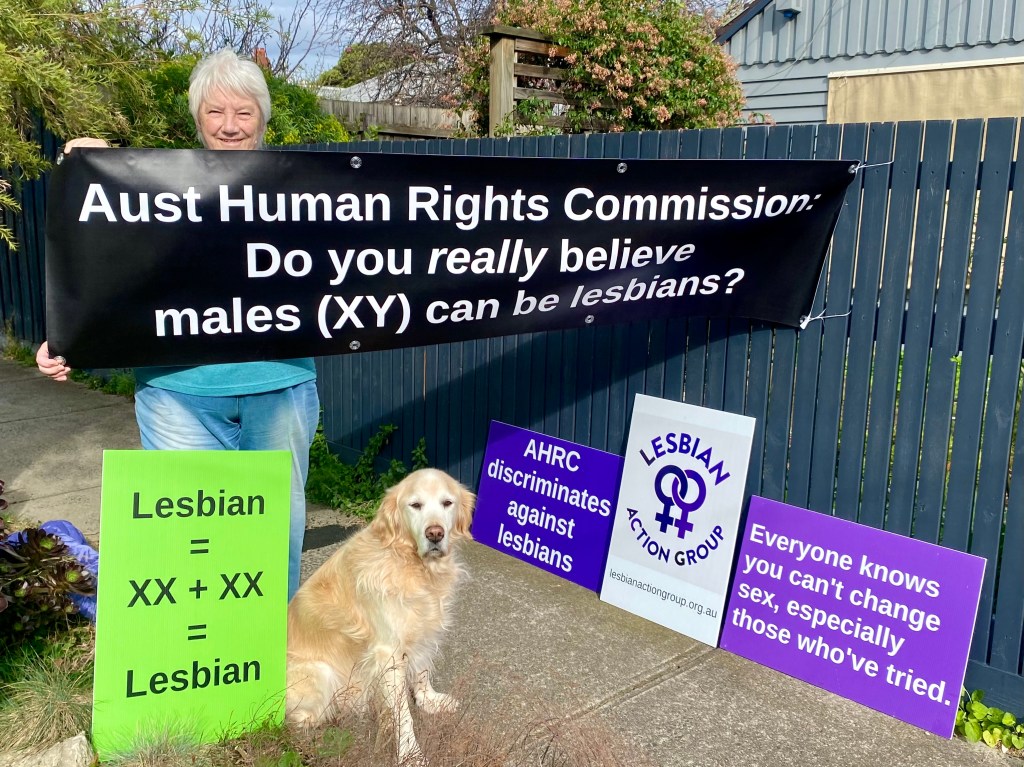
How did you reach the point of asking the Australian Human Rights and Equal Opportunity Commission to allow lesbian women to meet without men?
It all started in 2023 after the Let Women Speak event in Melbourne. Many of us attended, and the experience fuelled our anger and determination. There were a lot of lesbians present, and we collectively decided that we needed to take action.
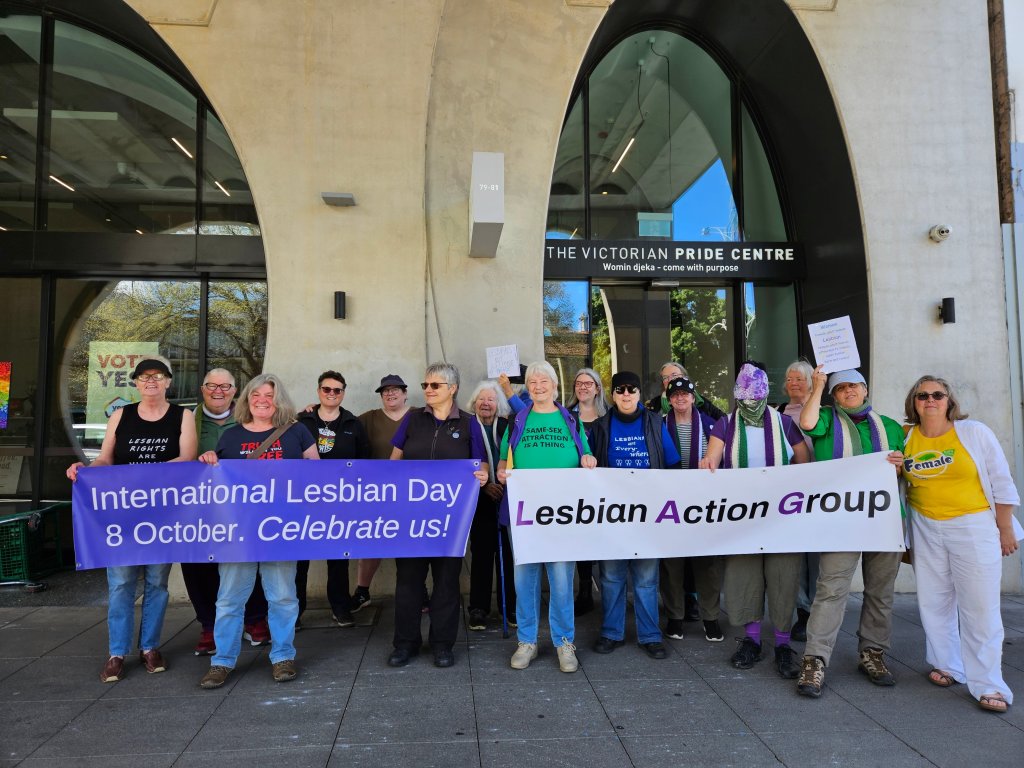
People need to understand that this issue has persisted for decades—trans-identified men infiltrating our venues, dismantling our spaces, and even taking us to court. As a result, we went underground, meaning we could no longer publicise our events. However, as we grew older and our numbers dwindled, we realised that enough was enough—we had to act. We decided to apply for an exemption from the Australian Human Rights Commission to host a lesbian-only (female-only) event for International Lesbian Day. We also applied to hold it at Melbourne’s Pride Centre.
The Pride Centre is a multimillion-dollar venue meant to serve lesbians, gays, bisexuals, and queer individuals. Theoretically, we should have been welcome to host our event there. However, we knew the political climate was against us and suspected that both the exemption request and the venue application would be denied. Our goal was to highlight the absurdity of the situation: that lesbians could not have their own event on International Lesbian Day in Australia.
Under the Sex Discrimination Act, groups can apply for a five-year temporary exemption to rectify imbalances affecting minority communities. We argued that lesbians, as a minority group, needed the right to female-only spaces. Over the past few decades, our spaces have been decimated, and our community eroded by the broader LGBTQ+ movement. We urgently needed to rebuild and reconnect.
When we applied to the Pride Centre, they quickly rejected our request, even though we informed them that we had applied for a legal exemption. They made it clear that they would not allow us to use the venue or advertise an event exclusively for female lesbians. It is ridiculous that we even have to specify “female lesbians” now.
To support our temporary exemption application, we gathered hundreds of letters of support. It was heartening to see such overwhelming backing. In contrast, the opposition gathered only about 80 letters compared to our 200-300. Some of our letters contained personal testimonies, while others presented strong legal arguments.
When the AHRC ruled on our case, they decided that we could hold a lesbian-only event—excluding heterosexual men, heterosexual women, and homosexual men—but we could not exclude men who identify as lesbians.
Wow.
Yes. We had the option to appeal, and we did. The hearing took place in September and lasted two days. The final ruling confirmed that lesbians cannot exclude men who identify as lesbians.
Given the current climate and the AHRC’s stance that people can change sex, we did not expect to win. Our barrister, Leigh Howard, was phenomenal.
If we lose again, we may choose to drop it, as further appeals require significant financial and emotional investment. However, on February 4, 2025, the Lesbian Action Group announced its decision to take the case to the federal court. We need to raise $20,000 to fund it.
If we win, we will host a lesbian-only event. However, if that happens, we expect fierce opposition from trans rights activists. Since this involves the AHRC, a victory on our part would likely prompt multiple appeals from activists across Australia. We will cross that bridge when we come to it.
If you win, do you expect men who identify as women to protest your event?
Absolutely. And that’s precisely why we’re doing this: to raise public awareness. If they show up to protest, it will attract media attention and expose the absurdity of men claiming to be lesbians. That’s part of our strategy.
Of course, in an ideal world, we would win the exemption, hold our events in peace, and that would be the end of it. But that’s unlikely. Whatever happens, we will ensure that our existing events remain unaffected.
Are many young lesbians involved in your group?
Most of us are older, but we are seeing an increase in younger lesbians joining us. Unfortunately, women under 40 have grown up immersed in gender ideology, making it difficult for them to break away. Their entire social circles are often tied to the LGBTQ+ community. If they leave, they risk losing their friends and being targeted for their views.
The young women who do reach out to us are often very isolated, but we are growing our numbers. Last year, we hosted a fantastic lesbian conference in Melbourne, where a panel of young lesbians spoke. They received a standing ovation. Many shared how difficult and isolating their experiences have been. Several of them are desisters—women who once subscribed to gender ideology but later rejected it.
Since the AHRC denied us the temporary exemption, we found a legal workaround: forming a membership-based lesbian club. As a registered club, we are allowed to hold female-only events. It’s not our ideal solution—we want to be able to openly advertise our gatherings—but it allows us to connect with more lesbians.
The club is now Australia-wide, with 208 members so far. We’ve reached many lesbians who weren’t previously part of the underground network. We maintain a full calendar of activities, including camps, conferences, game days, regular lunches, Zoom meetups, and art gallery excursions. Our younger members are particularly enjoying these events. We also run a monthly Zoom meeting for lesbians under 30, which has been well received.
It started in the 1980s. What was happening at that time?
In the 1980s, trans-identified males were beginning to push their way into lesbian spaces. This led us to explicitly state in our event advertising that our gatherings were “for lesbians born female.” This became necessary as we organised our annual national lesbian conferences.
By the early 1990s—around 1991 or 1993—I was on the organising committee for one of these conferences. At that time, our events were huge, attracting over 2,000 lesbians to conferences, festivals, and even concerts at the Sydney Opera House. It was an incredible time, but we also started to become more cautious.
When did things start to change?
A pivotal moment came when we attended a national lesbian conference in Brisbane. Unbeknownst to us, trans-identified men had infiltrated the organising collective. When we arrived and realised this, it caused an uproar. It wasn’t pleasant—it created a rift in the community.
This division became clear: some believed that trans-identified males were women, while others, like myself, disagreed. This schism started to fragment the lesbian community, and many of us chose to go underground. We began organising private, live-in lesbian-only events instead of the public gatherings we had held before. These gatherings were crucial, as many lesbians would go weeks without seeing another lesbian.
How did the trans lobby become aware of your gatherings?
At the time, we only advertised in lesbian-specific media—mostly print magazines and newsletters. Despite this, the trans lobby found out and filed a complaint against us. We had no idea how the legal system worked, so we contacted the tribunal for advice. They suggested we apply for an exemption, which would allow us to hold our lesbian-only event legally. So, we did—and we won. This was around 1993.
Winning that exemption was a big deal. We were ecstatic. However, the trans lobby immediately appealed the decision. They had vast resources and monitored everything. Their appeal led us back to the tribunal, and everything seemed to be in our favour—until a technicality derailed us. We had not disclosed a previous complaint against us, simply because we weren’t aware we needed to. As a result, the tribunal threw out our exemption.
After that, lesbians had no choice but to go completely underground. We only advertised events to women we absolutely trusted. If you weren’t in the know, you simply didn’t know what was happening. Despite our caution, years later at another conference in Adelaide, word accidentally got out, and the organisers were taken to court. That case cost them $10,000 to fight.
This is why we have been so careful ever since—because these gatherings are essential for us. They are our lifeline, a place to reconnect with friends from all over the country.
Did you feel forced into activism, or was it something you always pursued?
I came out as a lesbian in my 30s. Before that, I was a teacher, always active in advocating for women’s equality. One of my teaching roles focused on increasing opportunities for girls in schools. But in the 1980s, even though there was lip service to equality, being openly lesbian in education would have cost me everything.
If I had come out as a lesbian teacher, I might not have been fired outright, but my work advocating for girls’ education would have been completely undermined. People would dismiss me, saying, “Of course she’d say that—she’s a lesbian.”
It was different for heterosexual women advocating for women’s rights. When lesbians spoke up, we were accused of “hating men.” That was when I decided I didn’t want to hide anymore. I resigned from teaching and became a full-time lesbian community development worker—earning barely anything but doing work I believed in.
From then on, I started organising lesbian events, conferences, and markets everywhere. It was a thrilling time—until the rise of trans ideology started pushing us out of our own spaces.
When did being a lesbian become “uncool”? Because in the 1990s, it was celebrated.
Things started to go downhill when the “alphabet soup” of LGBTQ+ identities expanded, and queer theory—along with postmodernism—began taking over public discourse.
Because we had gone underground, many of us were unaware of the creeping influence of queer theory. We didn’t fully realise what was happening until the Let Women Speak rally. That was a wake-up call. The sheer hatred, vitriol, and violence directed at women—especially lesbians—was shocking.
The backlash didn’t just come from trans activists being held back by police; it came from the government and the media as well. I had stepped back from activism for a while, but that event pulled me right back in.
It feels like trans ideology has been pushed into government policies without community
consultation. Am I crazy to think this?
I don’t think you’re crazy. I think this is patriarchy and capitalism on steroids. It’s a multi- pronged attack fuelled by male privilege, fetishes, corporate greed, and the pharmaceutical industry. There’s huge money behind it.
Jennifer Bilek has done great work exposing the financial and organisational forces driving this movement. But beyond the money, there’s a cultural contagion happening.
Look at teenage girls—it’s always been a rite of passage for them to rebel, do something outrageous. If left alone, they’d grow out of it. But instead, predators have latched onto this and weaponised it. That’s what makes it sinister.
I attended the Let Women Speak rally in Adelaide, where the protesters were much closer. It was a sea of young women, with a few men dressed as women scattered among them. It broke my heart to see all these girls fiercely defending these men.
If this were just teenage rebellion, it wouldn’t be so dangerous. But this isn’t organic—it’s an indoctrination. That’s what brought me back to activism.
Do you think this movement is harming children?
Absolutely. As a teacher, I had to do mandatory child abuse training every year. If we suspected abuse, we were legally required to report it. Yet, when I started seeing videos of young kids being medically transitioned, I kept thinking, “This is child abuse. Why has mandatory reporting been abandoned? Why are people not only ignoring it but championing it?”
With lesbian issues, we found ways to survive underground. But with this, I couldn’t stay silent.
Do you think younger generations have lost touch with feminism?
Yes. They’ve grown up without any real understanding of feminism. Women’s rights had come so far, and this new generation never had to fight for basic equality.
Even worse, feminism has been demonized. I’ve spoken to women who studied gender at university and were not allowed to read foundational feminist texts. How can you understand oppression if you’re forbidden from studying it?
Without this historical and political context, young women are left defenceless against an ideology that exploits them. They are easy targets.
Would you say trans activism is cult-like?
It is a cult. It has all the hallmarks of one.
Where do you think this is going?
There’s going to be a reckoning. We’re already seeing desisters and detransitioners speaking out. Many of them feel like victims of medical experimentation.
At 18 or 20, you don’t understand the full weight of your decisions. Imagine waking up at 30, 40, and realising the damage is irreversible. That’s where I see this heading—massive regret and anger.
How depressing.
It is. But the fight isn’t over yet.
What would you say to young women today?
I would encourage young women to love themselves as they are. Looking back, life is about following your gut and making decisions as you go. I believe it’s better to accept life and go with the flow. When I reflect on my life, I see that I had a great one—even with two kids by 20 and a husband who felt like a third child. Being a lesbian came with hurdles to overcome, but despite everything, it has been a wonderful life. We live in a privileged country—why wouldn’t it be a wonderful life? Maybe that’s why we are so susceptible to simply being kind.
What are some of the feminist books you read and would recommend?
Some of the feminist books I read in the 1970s and 80s changed my life. They made sense of the world, spoke to my experiences, and gave me a framework to understand everything. I can’t remember all of them now, but I read voraciously. It was life-changing—a paradigm shift. Once your perspective shifts and you see the world through a feminist lens, you can’t unsee it.
For me, everything happening now is largely a feminist issue. It’s about patriarchy. When I look at global conflicts, I see patriarchal structures at play—men, their egos, their power struggles, and their violence. Even the men caught up in it become cannon fodder.
When I look at protests, like those for Palestine, people say it’s about activism. But I see something else. It’s primarily men protesting, feeding off the adrenaline and violence. There’s no altruism—just excitement and aggression. That’s what I see when I look at the world.
Join Carole Ann at the Lesbian Action Group or The Lesbian Club. The views expressed by the women interviewed in Local Action are their own and do not necessarily represent or reflect the positions of AAWAA.
